
SUDS Scale: Subjective Units of Distress
Use the rating as a brief description of distress, rather than a number you must get exactly right. You do not need to reach a particular score for practice to count. If repeated rating becomes checking, discuss how to use the scale more flexibly.
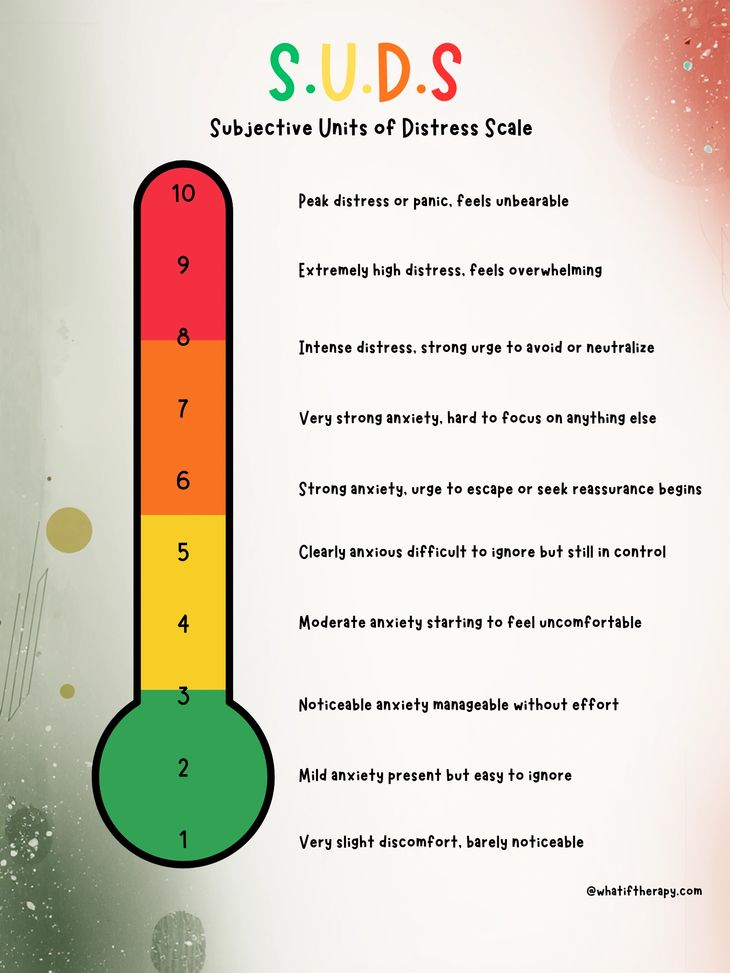
A guide to the Subjective Units of Distress Scale, a 0–10 anxiety chart used to rate emotional distress in the moment.
The SUDS scale, short for Subjective Units of Distress Scale, is a simple tool used to measure emotional distress on a scale from 0 to 10.
It is most commonly used in therapy settings. But it can also be used in schools, hospitals, coaching, and personal self-monitoring.
How the SUDS Scale Works
The SUDS scale typically ranges from 0 = no distress at all to 10 = extreme distress or panic.
Most versions use a 1–10 format. Some include 0–100 variations. But the 10-point version is the most common in clinical practice.
No anxiety, fear, stress, or discomfort is present.
Distress is present. But it is low and easy to manage.
The discomfort is clear. But the person can still stay engaged.
Distress takes more attention and may feel harder to tolerate.
There may be a strong urge to escape or avoid. Physiological symptoms are often present.
Distress feels very intense and may feel overwhelming in the moment.
The numbers are subjective. There is no “correct” rating.
Two people can experience the same situation and report very different SUDS levels. That is expected. The scale measures perception, not objective danger.
Printable SUDS Scale
Download and save this SUDS Scale for therapy, exposure exercises, anxiety tracking, ERP homework, or trauma treatment.
No email address required. The PDF is formatted for standard letter-size printing.
What brings you to the SUDS scale?
Distress ratings can play different roles depending on the symptoms and treatment approach. Choose the path that best matches what you want to understand.
Intrusive thoughts, rituals, or repeated checking?
See how SUDS ratings may be used during Exposure and Response Prevention while you practice approaching triggers and changing compulsions, reassurance seeking, and avoidance.
Trauma memories, reminders, or avoidance?
Learn how distress ratings may support Prolonged Exposure as adults gradually work with trauma memories and situations they have been avoiding.
What the SUDS Scale Measures
The SUDS scale measures:
- Anxiety
- Emotional distress
- Fear
- Discomfort
- Disgust
- Unsettledness
- Stress intensity
What It Does Not Measure
It does not diagnose a condition. It does not determine whether something is safe or unsafe. It simply measures how intense something feels.
The score is a communication tool. It is not a judgment and not a test.
Why the SUDS Scale Is Helpful
Emotions can feel vague and overwhelming. Numbers create clarity.
Track change
The SUDS scale helps people track emotional changes over time and notice patterns.
Communicate distress
It gives clients, families, and therapists a shared way to talk about anxiety and discomfort.
Measure progress
It can help compare situations and measure progress across practice, exposure, and treatment.
In therapy settings, it provides structure. In everyday life, it builds awareness. Many people find that simply naming their level of distress reduces confusion and increases a sense of control.
The SUDS Scale in Exposure Therapy, ERP, and PE
While the SUDS scale can be used broadly, it is especially important in Exposure Therapy, Exposure and Response Prevention (ERP), and Prolonged Exposure (PE).
It is used in the treatment of many conditions, including OCD, illness anxiety, generalized anxiety, specific phobias, panic disorder, agoraphobia, and trauma-related symptoms.
In these treatments, individuals gradually approach feared thoughts, situations, memories, or sensations instead of avoiding them.
Anxiety naturally rises during exposure. That rise is expected.
Before exposure
The SUDS scale can measure anxiety before exposure starts.
During exposure
It can track peak distress and show how the body responds over time.
After exposure
It can help compare learning across sessions and reduce avoidance.
Over time, individuals learn that distress can rise and fall without avoidance or compulsive behavior.
The SUDS number becomes a data point in that learning process. Importantly, the goal is not to reach zero anxiety. The goal is to increase tolerance and reduce avoidance.
Using a distress scale but still feeling stuck?
Tracking anxiety can help you notice patterns, but measurement alone does not change avoidance, compulsions, or fear. Structured exposure-based therapy can help you practice responding differently.
Professional support may be useful when fear or distress is causing you to:
- Avoid places, activities, memories, or physical sensations
- Rely on rituals, checking, reassurance seeking, or safety behaviors
- Organize daily life around preventing or escaping anxiety
- Understand the pattern but still feel unable to change it
How SUDS Connects to Treatment
The SUDS scale can support exposure-based treatment for many concerns. These pages explain the conditions and approaches where SUDS ratings may be used.

Matthew Baker, LCSW
Licensed in California and available to clients throughout the state via secure telehealth.
Matthew specializes in ERP for OCD, diagnosis-appropriate exposure-based treatment for anxiety disorders, and Prolonged Exposure for PTSD.
The SUDS Scale is one of many practical tools used during treatment to help track emotional distress, guide exposure exercises, and measure progress over time.
Phone: 714-686-9447
Email: Matt@whatiftherapy.com
This page is educational and does not replace individualized clinical care.
Ask about current appointment availability during your consultation.
Ready to take the next step?
Start with a free 15-minute consultation. We will look at fit, goals, and whether this type of treatment makes sense for you.
Schedule a free 15-minute consultationFrequently Asked Questions About the SUDS Scale
Is the SUDS scale scientifically validated?
The SUDS scale is widely used in cognitive behavioral therapy and exposure-based treatments. It is considered a reliable subjective measure of emotional distress.
Is the SUDS scale only for OCD and anxiety?
The SUDS scale is not limited to Obsessive-Compulsive Disorder and anxiety. It can be used to measure distress across a range of experiences, including fear, panic, and PTSD. It is commonly used in work with OCD as well as in trauma-focused treatments, allowing you to track changes in distress in a consistent, structured way across different situations.
What is a high SUDS score?
Generally, scores of 7–10 indicate high distress. However, interpretation depends on context.
Who identifies the SUDS score?
The SUDS score is selected by the individual experiencing the distress — not the therapist.
SUDS stands for Subjective Units of Distress. This means the rating reflects the person’s own internal experience. There is no correct or incorrect number. The therapist does not assign the score or adjust it.
The role of the therapist is to ask for the rating, clarify what the number represents, and help track patterns over time. But the number itself always comes from the client. If a therapist were to choose the number, it would no longer be subjective.