
Behavioral Therapy Insights
Talk Therapy vs ERP for OCD: What Treatment Needs to Address
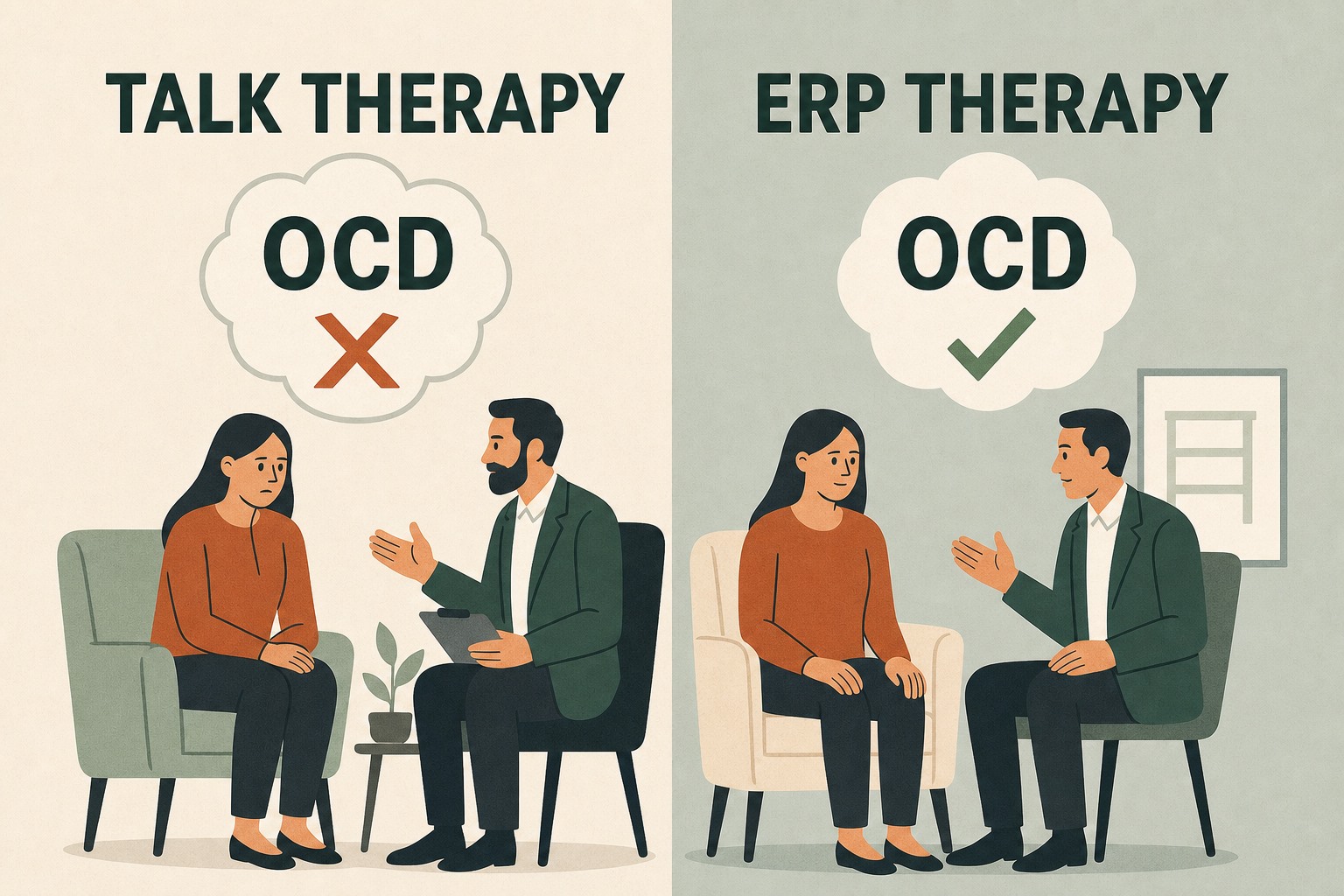
ERP is a form of cognitive behavioral therapy, or CBT, that directly addresses OCD obsessions and compulsions. Supportive discussion can help you feel understood, but an OCD treatment plan also needs to address the repeated responses that keep you stuck.
“Talk therapy” is a broad term. It includes many approaches, so the label alone cannot tell you whether treatment fits your needs.
How is ERP different from discussing the thought?
Talking about an intrusive thought can help a clinician understand your experience. In ERP, the work then includes practicing a different response to the trigger: reducing checking, avoidance, reassurance, or mental review rather than repeatedly resolving the thought's meaning.
For example, someone who repeatedly asks whether they made a mistake may receive temporary relief from another explanation. An ERP plan can address the urge to keep asking and the difficulty moving on without certainty.
The IOCDF overview of ERP describes exposure and response prevention as a specific form of CBT used in OCD treatment.
Can supportive conversation still be useful?
Yes. Understanding, trust, practical problem-solving, and discussion of other concerns can support care. A single reassuring statement does not show that therapy is harmful. The concern is a recurring pattern in which settling the same obsession replaces work on the rituals around it.
The plan should consider other needs too, including depression, trauma, relationships, or medical concerns. These should not be dismissed as irrelevant just because OCD is present.
What should an OCD treatment plan explain?
- Which symptoms and compulsions are being targeted.
- How practice connects to daily goals.
- How visible and mental rituals will be addressed.
- What between-session work is appropriate.
- How progress and barriers will be reviewed.
Early sessions may focus on assessment and preparation. It is not necessary for every appointment to contain the same exercise for treatment to be legitimate.
What if previous therapy did not help?
Ask what approach was used and what might be different in a new plan. Limited progress can have several explanations, including missed mental rituals, other conditions, or a need for more support. It does not mean you failed or that all prior care was worthless.
The questions for reviewing stalled OCD therapy can help structure that conversation. For getting started, see your first ERP sessions and the practice's ERP service page.

Matthew Baker, LCSW
California Licensed Clinical Social Worker #121926 specializing in ERP for OCD and anxiety and Prolonged Exposure for PTSD. View Matthew's profile.