Whatif Therapy ERP · PE · Telehealth CA

OCD & Anxiety Education, Online Therapy in California

Why Reassurance Makes OCD Worse and What Actually Helps

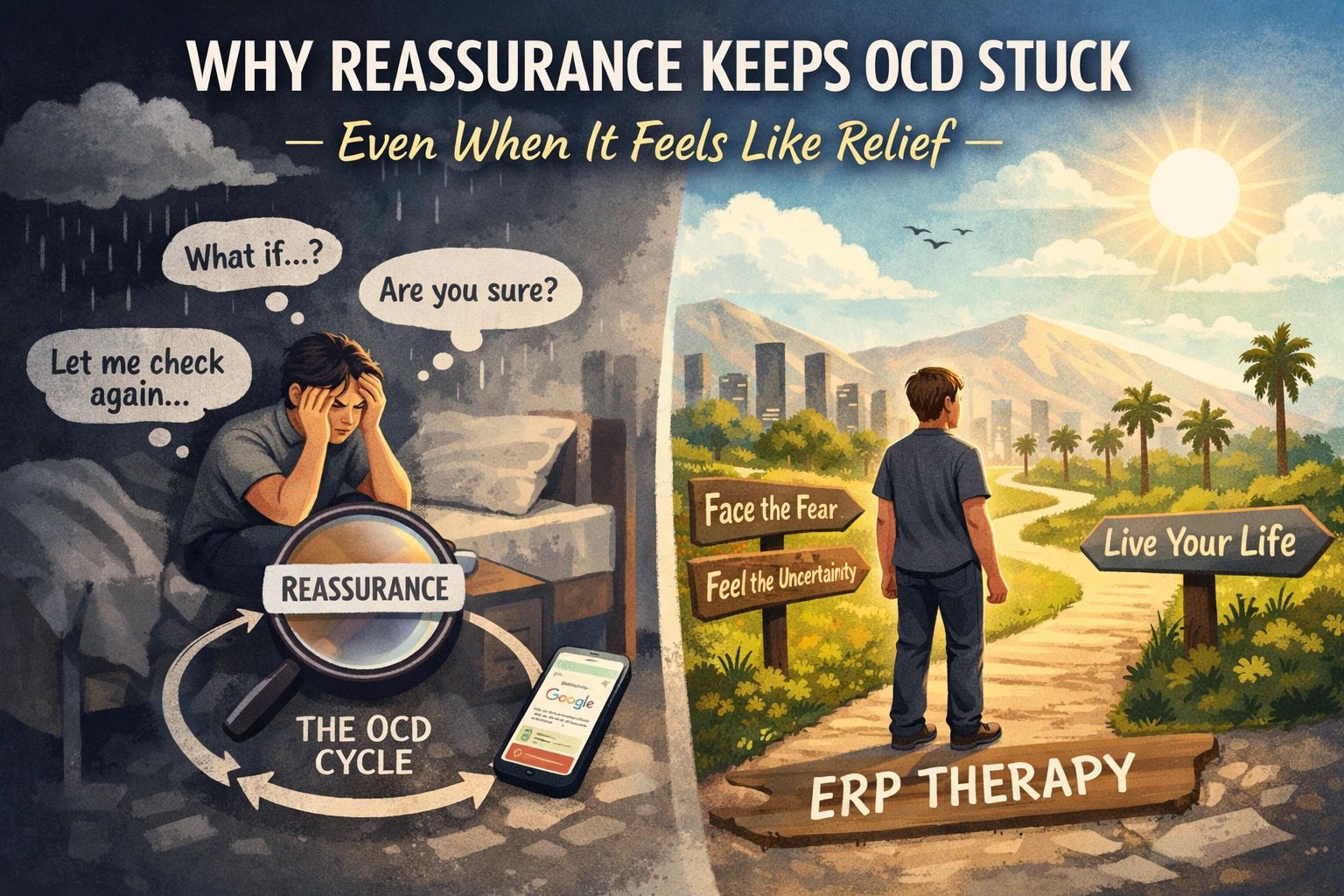
How reassurance makes OCD stronger over time


If you have OCD, you probably already know this feeling.

A thought shows up out of nowhere.
Your chest tightens.
Your mind locks onto one terrifying possibility.

So you look for relief.

You ask someone you trust.
You Google.
You replay memories in your head.
You tell yourself, “This doesn’t mean anything… right?”

And for a moment, it works.

The anxiety eases. Your body settles. You can breathe again.

But then maybe minutes later, maybe hours — the thought comes back.
This time louder. This time more convincing.

If this sounds familiar, you’re not broken — and you’re not doing anything wrong.

This is how OCD operates.


As an Exposure and Response Prevention (ERP) therapist based in Los Angeles, California, I work with people across the state of California who feel trapped in this exact cycle. Understanding why reassurance backfires is often the first step toward getting unstuck.

Why Reassurance Feels So Necessary

When you’re anxious, reassurance feels like survival.

Your brain is screaming “Danger!” and reassurance feels like the fastest way to turn the alarm off.

It makes sense that you’d want:

  • Certainty
  • Clarity
  • Proof that you’re safe, good, or okay

The problem isn’t that you want relief.

The problem is that OCD teaches your brain that relief must come from certainty — and certainty is something OCD will never allow you to keep.

Why the Relief Never Lasts

Reassurance works briefly because it lowers anxiety right now.

But underneath that relief, something else is happening.

Your brain quietly learns:

“I survived this feeling because I checked.”

That lesson sticks.

So the next time:

  • The thought shows up faster
  • The anxiety spikes higher
  • The urge to reassure feels more urgent

You may notice:

  • Reassurance lasts for shorter periods
  • You need it more often
  • You start doubting the reassurance itself

This is why many people say:

“I already know the answer… but it doesn’t feel convincing anymore.”

That’s not a failure of logic.
It’s how OCD strengthens itself.


Reassurance Is Part of the OCD Cycle

Many people are surprised to learn that reassurance is actually a compulsion.

Not because it’s bad — but because of what it’s trying to do.

Reassurance is any action meant to:

  • Make anxiety go away
  • Eliminate doubt
  • Feel certain again

That can look like:

  • Asking others to confirm your fears aren’t true
  • Mentally reviewing your intentions or memories
  • Googling symptoms or scenarios
  • Repeating phrases to yourself to feel “okay” 

Even when reassurance happens silently in your mind, OCD treats it the same way.

It keeps the cycle going.


What ERP Does Differently

ERP (Exposure and Response Prevention) doesn’t ask you to prove OCD wrong.

It doesn’t try to convince you that your fears aren’t real.

And it doesn’t aim to make anxiety disappear.

Instead, ERP helps you practice something that feels counterintuitive at first:

  • Allowing uncertainty
  • Letting anxiety exist without fixing it
  • Resisting the urge to reassure — even mentally
  • Learning that discomfort can rise and fall on its own

Over time, your brain learns a new lesson:

“I can feel uncertain and still live my life.”

That learning — not reassurance — is what loosens OCD’s grip.


How Reassurance Shows Up in Different OCD Themes

The content of OCD changes, but the pattern stays the same.

  • Health Anxiety: Seeking reassurance from doctors, tests, or symptom searches
  • Relationship OCD: Needing certainty about love, attraction, or commitment
  • POCD: Reassuring yourself about intent, character, or meaning
  • Harm OCD: Checking for safety or replaying scenarios to feel sure

Different fears. Same cycle.

ERP focuses on breaking the cycle — not debating the fear.

When Information Helps — and When It Hurts

Learning about OCD can be empowering.

Helpful education:

  • Explains how OCD works
  • Helps you recognize compulsions
  • Supports ERP skills

But education becomes unhelpful when it’s used to:

  • “Finally prove” a fear wrong
  • Get one more hit of certainty
  • Feel calm before moving forward

ERP isn’t about feeling ready.
It’s about practicing without certainty.


If You Feel Stuck, You’re Not Failing

Many people tell me:

  • “I understand OCD — I just can’t stop.”
  • “I’ve talked about this a lot, but nothing changes.”
  • “I know reassurance doesn’t help… but I still need it.”

That doesn’t mean you’re resistant or unmotivated.

It usually means reassurance — even well-intended reassurance — has become woven into the cycle.

ERP offers a structured way out.

ERP Therapy in Los Angeles & Throughout California

I provide ERP therapy for OCD and anxiety disorders via telehealth across California, including Los Angeles County, Orange County, and San Diego.

My work focuses on:

  • Helping you reduce compulsions (including reassurance)
  • Building tolerance for uncertainty at your pace
  • Creating lasting change — not temporary relief

If you’re looking for OCD treatment that addresses what actually keeps the cycle going, ERP may be a good fit.

You can learn more about ERP therapy for OCD in California or schedule a consultation to see if this approach feels right for you.

Matthew Baker, LCSW

Matthew Baker, LCSW

California Licensed Clinical Social Worker #121926 specializing in ERP for OCD and anxiety and Prolonged Exposure for PTSD. View Matthew's profile.


Ready to take the next step?

Whatif Therapy provides secure telehealth for clients located throughout California.

Schedule a free 15-minute consultation