
Professional Referral Guide
When Should a Therapist or Psychiatrist Refer for Specialized OCD Care?
A practical guide for therapists and psychiatrists deciding when to refer a patient or client for specialized OCD assessment and ERP treatment.
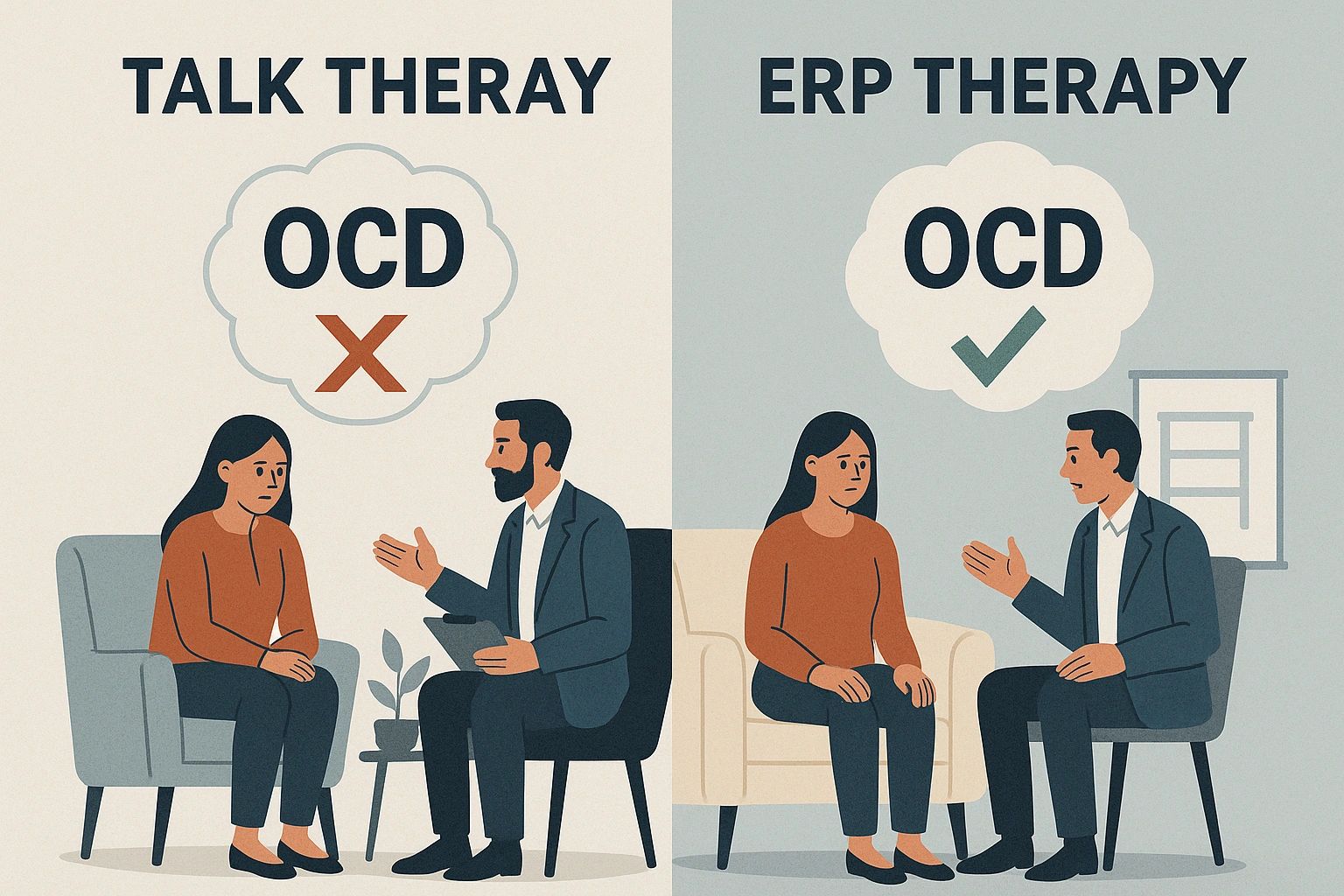
Recognizing obsessive-compulsive disorder is not always straightforward.
Some patients describe visible contamination or checking rituals. Others present with persistent guilt, relationship doubt, health concerns, disturbing intrusive thoughts, repeated reassurance seeking, or hours of internal analysis. The compulsive part of the pattern may be almost entirely mental.
For therapists, psychiatrists, physicians, and other professionals, the referral question is rarely as simple as whether a patient has an OCD diagnosis. A more useful question is whether obsessive fear, avoidance, or compulsive attempts to gain certainty have become important treatment targets—and whether specialized assessment or Exposure and Response Prevention could add something the current treatment is not providing.
This guide describes circumstances in which consultation, adjunctive treatment, or referral to an OCD-focused therapist may be helpful.
OCD may be present even when rituals are not obvious
OCD is often easier to recognize when compulsions are observable. Washing, checking locks, repeating actions, or arranging objects may quickly suggest an obsessive-compulsive pattern.
However, many compulsions happen internally or blend into ordinary behavior. A patient may repeatedly:
- Review conversations, memories, or decisions
- Analyze whether a thought reveals something about their character
- Check feelings, attraction, intentions, or bodily reactions
- Seek reassurance from clinicians, partners, relatives, or online sources
- Confess thoughts or past actions to reduce guilt
- Compare current experiences with earlier ones
- Research symptoms, morality, relationships, or health risks
- Avoid people, places, objects, words, media, or responsibilities
- Repeat a thought or phrase until it feels complete
These behaviors can resemble productive reflection, insight-oriented work, responsible risk assessment, or generalized worry. Their function is often more informative than their appearance. A behavior may be compulsive when it is repeatedly used to eliminate uncertainty, neutralize distress, establish safety, or make an internal experience feel resolved.
Signs that a specialized OCD consultation may help
A referral does not require certainty about the diagnosis. Consultation may be useful when one or more of the following patterns are present.
Treatment repeatedly returns to the same unresolved question
Sessions may repeatedly revolve around questions such as “What if I harmed someone?”, “What if this memory means I did something wrong?”, “How can I know what I truly feel?”, or “Can you tell me whether this thought means something?”
Discussion produces temporary relief, but the patient returns with a new detail, exception, memory, sensation, or hypothetical possibility that appears to require further analysis. This can indicate that therapy is being pulled into an attempt to resolve obsessional doubt.
Reassurance has become part of the therapeutic relationship
Compassionate validation is important. Reassurance becomes clinically relevant when the patient increasingly relies on the clinician to confirm that a feared outcome is unlikely, an intrusive thought is meaningless, or they are not a bad or dangerous person.
Relief after reassurance may be genuine and brief. If the patient needs the same conclusion repeatedly—or asks increasingly specific versions of the same question—the reassurance may be functioning as a compulsion. Specialized consultation can help distinguish emotional support from participation in an OCD cycle.
Insight has increased, but behavior has not changed
A patient may understand the origins of a fear, recognize cognitive distortions, and describe the OCD cycle accurately while remaining highly avoidant or dependent on rituals.
Insight can be valuable, but understanding alone may not change a pattern maintained by short-term relief. The patient may need structured practice approaching triggers, allowing uncertainty, and reducing the responses that reinforce fear.
The patient reports rumination that behaves like a ritual
In OCD, repetitive thinking may be an active attempt to solve uncertainty. Examples include reconstructing an event, reviewing motives, testing emotional reactions, debating an intrusive thought, searching for the perfect explanation, or mentally checking whether treatment is working.
Because these responses are covert, both patient and clinician may underestimate the time they consume.
The case involves highly stigmatized intrusive thoughts
Patients may hesitate to disclose intrusive sexual, violent, religious, moral, or identity-related thoughts. They may fear being judged, reported, misunderstood, or treated as though the thought reflects intent.
A clinician familiar with OCD can assess the broader pattern without assuming that all disturbing thoughts are obsessional or that every risk concern should be dismissed. The task is careful assessment—not automatic reassurance and not automatic pathologizing.
Standard anxiety interventions have stalled
Relaxation, cognitive restructuring, grounding, and coping skills can be useful in many contexts. In some OCD presentations, the patient may begin using these strategies to neutralize thoughts, obtain certainty, or escape uncertainty.
The issue is not that a technique is universally helpful or harmful. Its function within the patient’s pattern matters. When each intervention becomes another way to make the thought go away, an OCD-specific formulation may clarify the next step.
Accommodation is affecting the family or treatment system
Parents, partners, clinicians, and other support figures may become involved by answering repeated reassurance questions, modifying routines, checking for the patient, participating in safety procedures, or helping the patient avoid triggers.
Accommodation usually develops from care and an understandable wish to reduce suffering. Over time, it can make the feared situation feel less manageable without assistance.
Referral does not always mean transferring the entire case
Specialized OCD treatment can take several forms. The appropriate arrangement depends on clinical needs, patient preference, provider scope, insurance, and the feasibility of coordination.
Full transfer of psychotherapy
A transfer may make sense when OCD is the primary concern and treatment needs to be organized around Exposure and Response Prevention, response prevention, and changes in avoidance.
Adjunctive OCD treatment
A patient may continue working with an established therapist while receiving focused OCD treatment from another clinician. This requires clear roles so the therapies do not unintentionally work against each other.
Professional consultation
A treating clinician may seek consultation regarding formulation, hidden compulsions, reassurance, accommodation, exposure planning, or whether a formal referral is warranted.
Medication management plus ERP
Psychiatrists and other prescribers may continue medication management while an OCD-focused therapist provides behavioral treatment. With the patient’s authorization, coordination can help providers understand symptom changes, functioning, adherence, side effects, and barriers to treatment. Medication decisions remain within the prescriber’s role.
Information that can make a referral more useful
The patient should generally make direct contact with the prospective therapist unless another process has been arranged.
With appropriate authorization and a secure communication method, useful information may include:
- The primary presenting concerns
- Current diagnoses and important differential considerations
- Observable and suspected mental compulsions
- Avoidance and functional impairment
- Prior therapy approaches and the patient’s response
- Relevant medication-management information
- Important safety or medical considerations
- Family accommodation or caregiver involvement
- The referring provider’s anticipated ongoing role
Ordinary email or website forms should not be used to send detailed protected health information unless the practice has identified a secure channel. A brief, non-identifying fit question is usually enough for an initial professional inquiry.
Questions to consider before referring
- Is the patient trying to achieve certainty that may not be obtainable?
- Do reassurance and analysis provide relief that quickly fades?
- Are repeated behaviors or mental acts linked to the fear?
- Has avoidance narrowed the patient’s life?
- Does therapy revisit the same doubt without changing the patient’s response?
- Are family members or clinicians being recruited into checking or reassurance?
- Are coping strategies being used rigidly to neutralize distress?
- Has the patient received a structured assessment for OCD symptoms?
- Would consultation, adjunctive treatment, or transfer create a clearer plan?
These questions do not establish a diagnosis. They help identify when a focused assessment may be useful.
When routine outpatient referral may not be enough
An OCD-focused outpatient practice may not be the appropriate level of care for every patient. Additional assessment or a higher level of support may be necessary when there is imminent risk, severe medical compromise, inability to meet basic needs, acute intoxication or withdrawal, a need for continuous monitoring, or severity that prevents meaningful participation in routine outpatient sessions.
Abrupt-onset symptoms in a child, significant eating restriction, severe skin damage from washing, medication complications, psychosis, mania, or other medical concerns may require coordination beyond outpatient psychotherapy. Specialized OCD care should be part of an appropriate clinical system, not a substitute for emergency, medical, or higher-level services.
Referring to Whatif Therapy
I am Matthew Baker, LCSW, owner of Whatif Therapy and a California Licensed Clinical Social Worker. I provide secure telehealth treatment for clients who are physically located in California during appointments.
My clinical work includes ERP for OCD, exposure-based treatment for anxiety disorders, treatment for adults, teenagers, and children with OCD or anxiety, and Prolonged Exposure for adults with PTSD.
I welcome inquiries from therapists, psychiatrists, physicians, pediatricians, school professionals, and other providers considering a referral. A brief professional inquiry can clarify scope, outpatient fit, age range, telehealth eligibility, insurance, and current availability.
For referral criteria and next steps, visit the Refer a Patient or Client page. Please avoid sending identifiable clinical information through ordinary email or voicemail.
Professional referral FAQ
Does a clinician need to confirm OCD before making a referral?
No. Consultation may be appropriate when OCD is suspected but not confirmed. Assessment is part of determining treatment fit.
Can a psychiatrist refer a patient for ERP while continuing medication management?
Yes. Medication management and ERP are often provided by different clinicians. With the patient’s authorization, providers can coordinate relevant aspects of care.
Can a general therapist remain involved?
Sometimes. Adjunctive treatment may be possible when provider roles are clear and the approaches are compatible. In other cases, transferring psychotherapy may produce a more coherent treatment plan.
What if the compulsions are entirely mental?
Mental review, rumination, neutralizing, checking feelings, self-reassurance, and attempts to solve uncertainty can all be clinically important. Their less visible nature is one reason specialized assessment may help.
Does Whatif Therapy provide emergency or intensive services?
No. Whatif Therapy provides scheduled outpatient psychotherapy through telehealth. It does not provide emergency, crisis, residential, hospital, or around-the-clock services.
A referral can begin with a question
You do not need complete diagnostic certainty before asking whether specialized care may be appropriate.
If treatment repeatedly becomes organized around intrusive doubt, reassurance, mental review, avoidance, or attempts to feel completely certain, an OCD-focused consultation may help clarify the formulation and next step.
Review professional referral information or contact Matthew Baker, LCSW at matt@whatiftherapy.com or 714-686-9447. Keep ordinary email and voicemail brief and non-identifying.
This article provides general professional education and does not replace patient-specific assessment, consultation, emergency evaluation, or applicable legal and ethical requirements.

Matthew Baker, LCSW
California Licensed Clinical Social Worker #121926 specializing in ERP for OCD and anxiety and Prolonged Exposure for PTSD. View Matthew's profile.